

If you operate in underground construction — whether with HDD rigs, mini excavators, or fiber equipment — chances are you’re transporting machinery daily.
But many contractors ask the same questions:
👉 At what weight do I need a CDL driver?
👉 Do I need a DOT number for my trucks and trailers?
Getting this wrong can lead to fines, job shutdowns, and serious liability risks.
This guide breaks it down in a simple, practical way.
Understanding Weight: The Key Factor
Everything starts with GVWR (Gross Vehicle Weight Rating).
👉 This is NOT the actual weight you’re carrying
👉 It’s the maximum allowed weight of:
- Truck
- Trailer
- Load combined
You must look at:
- Truck GVWR
- Trailer GVWR
- Combined GVWR (GCWR)
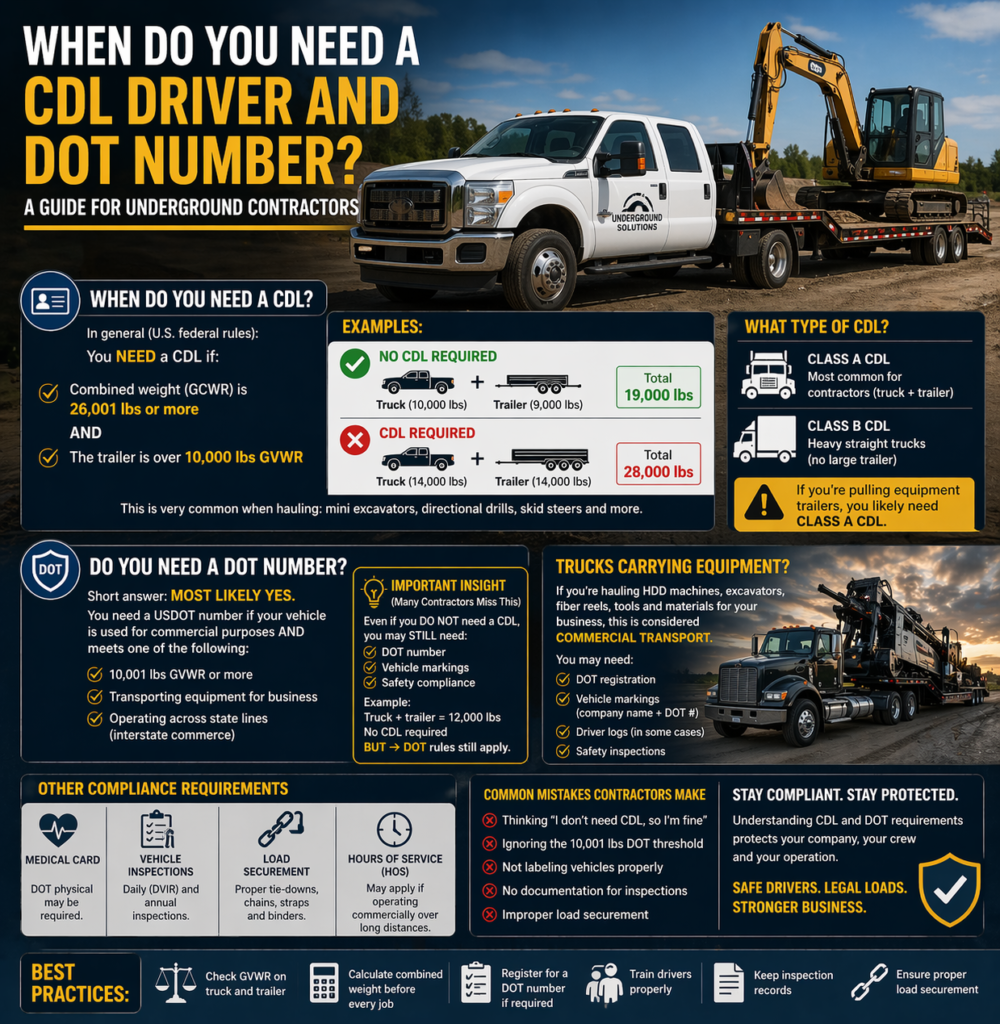
When Do You Need a CDL?
In general (U.S. federal rules):
You NEED a CDL if:
👉 Combined weight (GCWR) is 26,001 lbs or more
AND
👉 The trailer is over 10,000 lbs GVWR
Examples (Real Underground Scenarios):
✔️ NO CDL Required
- Pickup (10,000 GVWR) + trailer (9,000 GVWR)
- Total = 19,000 lbs
✔️ CDL REQUIRED
- Pickup (14,000 GVWR) + trailer (14,000 GVWR)
- Total = 28,000 lbs
👉 This is VERY common when hauling:
- Mini excavators
- Directional drills
- Skid steers
What Type of CDL?
- Class A CDL → Most common for contractors (truck + trailer)
- Class B CDL → Heavy straight trucks (no large trailer)
👉 If you’re pulling equipment trailers → you likely need Class A
Do You Need a DOT Number?
Short answer: Most likely YES.
You need a USDOT number if:
👉 Your vehicle is used for commercial purposes
AND meets one of the following:
- 10,001 lbs GVWR or more (VERY important threshold)
- Transporting equipment for business
- Operating across state lines (interstate commerce)
Important Insight (Many Contractors Miss This)
Even if you DO NOT need a CDL, you may STILL need:
👉 DOT number
👉 Vehicle markings
👉 Safety compliance
💡 Example:
- Truck + trailer = 12,000 lbs
- No CDL required
- BUT → DOT rules still apply
What About Trucks Carrying Equipment?
If you’re hauling:
- HDD machines
- Excavators
- Fiber reels
- Tools and materials
👉 This is considered commercial transport
So you may need:
- DOT registration
- Vehicle markings (company name + DOT #)
- Driver logs (in some cases)
- Safety inspections
Florida-Specific Considerations
Florida follows federal FMCSA guidelines, but enforcement can be strict.
You may be stopped for:
- Weight checks
- Load securement
- CDL verification
- DOT compliance
👉 Non-compliance can result in:
- Fines
- Vehicle taken out of service
- Project delays
Other Compliance Requirements
Depending on your setup, you may also need:
1. Medical Card (DOT Physical)
Required for many commercial drivers
2. Vehicle Inspections
- Daily inspections (DVIR)
- Annual inspections
3. Load Securement
- Chains, straps, binders
- Proper tie-down methods
4. Hours of Service (HOS)
- May apply if operating commercially across longer distances
Common Mistakes Contractors Make
❌ Thinking “I don’t need CDL, so I’m fine”
❌ Ignoring the 10,001 lbs DOT threshold
❌ Not labeling vehicles properly
❌ No documentation for inspections
❌ Improper load securement
👉 These are some of the most common reasons for roadside fines.
How to Stay Compliant
Best Practices:
- Check GVWR on both truck and trailer
- Calculate combined weight before every job
- Register for a DOT number if required
- Train drivers properly
- Keep inspection records
- Ensure proper load securement
Final Thoughts
Understanding CDL and DOT requirements is not just about avoiding fines — it’s about protecting your company, your crew, and your operation.
As your business grows and you start moving heavier equipment, compliance becomes even more critical.